


.png)
Population Health Partners (PHP) is a New York-based investment firm that creates companies and develops drugs to tackle population-scale health challenges. The team behind PHP includes Dr. Clive Meanwell, the founder of the Medicines Company; Whit Bernard, founder and CEO of Metsera, and several other successful drug hunters. Edison Scientific develops specialized AI agents for scientific research and development. Edison’s flagship agent, Kosmos, does months of work autonomously, and is trained on drug development tasks ranging from target identification to regulatory document authoring.
The challenge
Taking a molecule from discovery to the clinic takes years and hundreds of millions of dollars. The gate into the clinic is the Investigational New Drug (IND) application, the sponsor's request to the FDA for permission to dose humans. Producing INDs is a major hurdle for drug developers. The application has to make a compelling case, show a clear view of the risks, and reflect a trial design that maximizes the odds of success or, for an early study, the amount of signal the trial will produce. Errors are expensive: any error or inconsistency in an IND can result in a clinical hold and delay the trial. Assembling an IND takes a team of experts across pharmacology, toxicology, pharmacokinetics, CMC, clinical development and regulatory affairs, and typically takes three to four months. Every month spent preparing an IND or responding to a clinical hold can be one more month that patients spend waiting, and one fewer month that developers could benefit from market exclusivity.
In June 2026, PHP and Edison Scientific launched a collaboration to leverage specialized Kosmos Clinical Protocol Design (CPD) and Kosmos Regulatory Authoring products to support PHP’s process of IND preparation. Edison applied these products to a PHP incubation program for a novel therapeutic preparing to run a Phase 2b study. This molecule has a long regulatory history, with preclinical and clinical materials running to tens of thousands of pages across multiple indications. The IND application has to synthesize this robust history accurately and rapidly, from a detailed but fragmented existing dataset. PHP and Edison hypothesized that Kosmos would allow PHP to prepare the IND more quickly, with fewer errors, and at significantly lower cost than if it had been prepared manually, or with the help of out-of-the-box LLMs.
The engagement
Edison deployed Kosmos CPD and Kosmos Regulatory Authoring and customized them for PHP’s IND-filing process.
1. Specializing Kosmos for IND authoring
The two teams started with the protocol synopsis, the document that describes trial design, rationale, endpoints and eligibility criteria. Edison collaborated with PHP to build a benchmark to score writing tasks on study design, rationale, endpoints and eligibility criteria for accuracy, persuasiveness and clarity. Edison then trained Kosmos to improve performance on the benchmark. The resulting trained version of Kosmos scored 81.5% (equal-weighted mean, five replicates per task), against 65.5% for a frontier general-purpose model. Qualitatively, this difference means “Kosmos produced documents of a much higher scientific quality and rigor than other LLMs, with fewer errors and better objectivity”, as per a team member at PHP.
“Kosmos produced documents of a much higher scientific quality and rigor than other LLMs, with fewer errors and better objectivity.”
Team Member, Population Health Partners
2. Reviewing INDs for errors with Kosmos
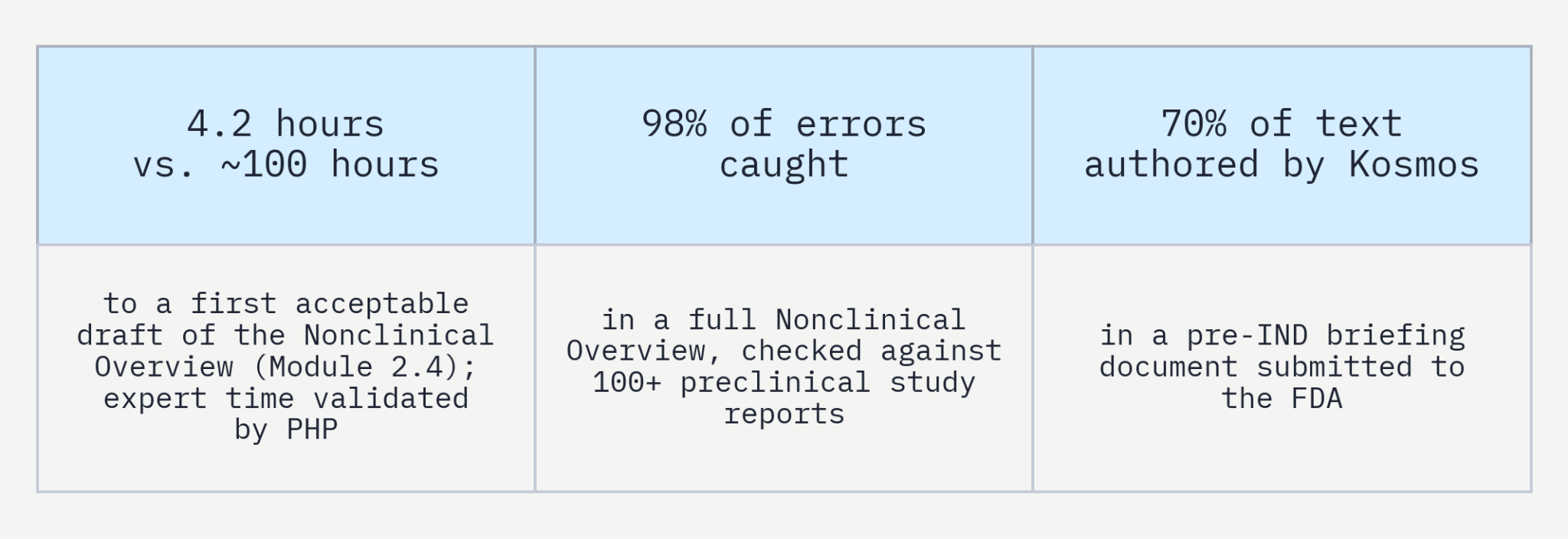
Edison then applied Kosmos Regulatory Authoring to catch potential errors in draft IND documents. To measure review, Edison planted source-data errors in a Module 2.4 Nonclinical Overview and asked Kosmos to find them against the full source package, citing the study report behind each correction. Kosmos Regulatory Authoring found 98% of errors, at a median of 14 minutes per error, running in parallel across the document. By contrast, PHP estimated that an expert checking claims and figures in the document would need 10 to 20 hours. Kosmos also succeeded in catching a real error in a draft pre-IND document being prepared for submission that had survived roughly fifteen reviewers.
“Probably fifteen people had looked at that document at various points, and none of us caught a hard-to-detect transposition error. Kosmos did.”
Team Member, Population Health Partners
3. Drafting documents for submission
Finally, Kosmos Regulatory Authoring drafted several of the key documents in the IND package: the protocol, protocol synopsis, Investigator's Brochure, Nonclinical Overview, Pre-IND Briefing Document and general investigational plan. Kosmos Regulatory Authoring produced a first acceptable draft of the Nonclinical Overview in 4.2 hours, against roughly 100 hours of expert time. Roughly 70% of the Pre-IND Briefing Meeting Request submitted to FDA was drafted by Kosmos and edited by PHP.
The outcome
As a result of the partnership, PHP's experts now spend their hours reviewing and deciding rather than drafting. PHP is now bringing Kosmos to a second program in an undisclosed indication and expects that it will reduce the amount of team time needed for IND preparation by ~75%, from ~4 months to ~1 month. PHP's own projection is that applying Kosmos more broadly across its programs could shorten the path from Phase 1 to launch by about two years, from seven to five.
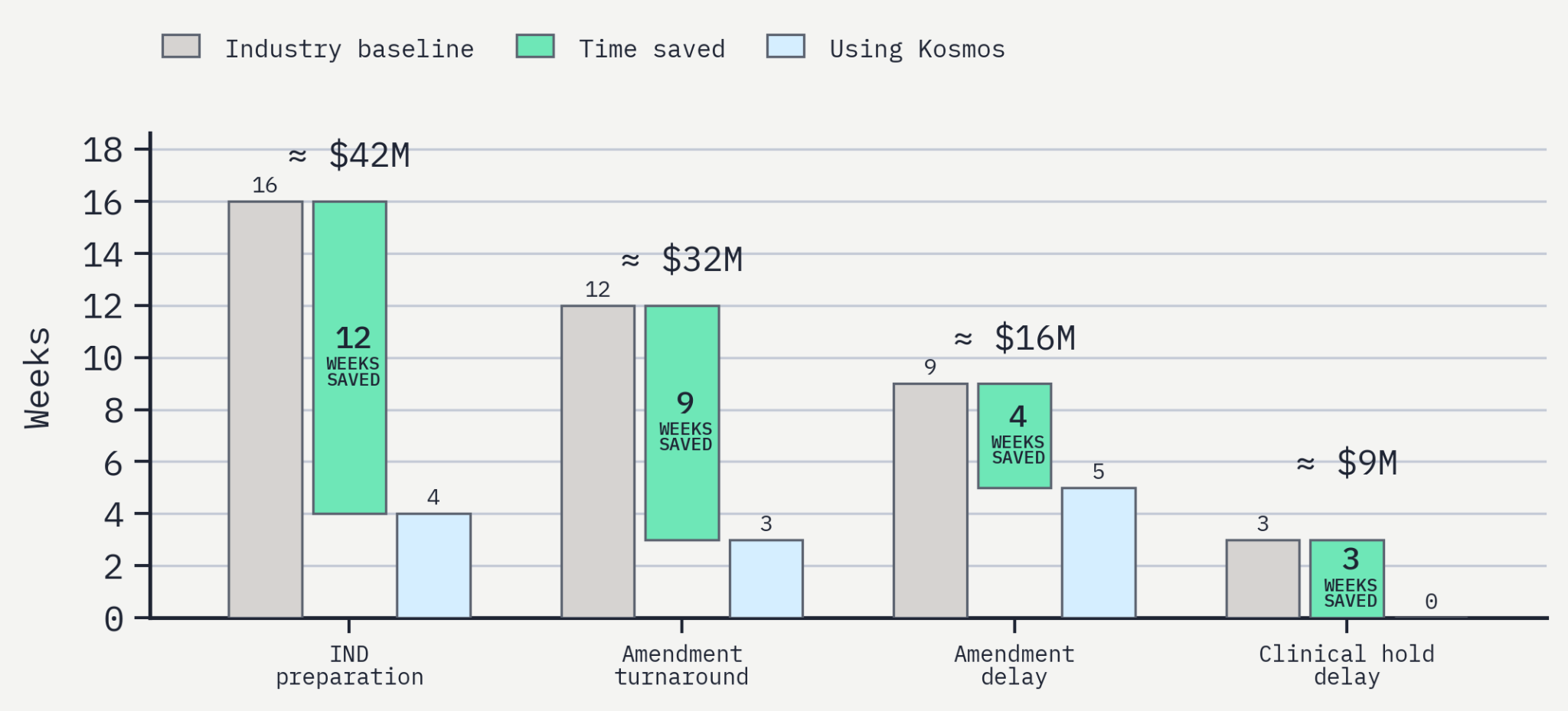
Combining Kosmos' speed in drafting regulatory documents with its ability to catch errors allows us to estimate the value provided by Kosmos to drug programs. By compressing IND preparation from 4 months to 1 month, Kosmos CPD and Kosmos Regulatory Authoring would allow for $42M in recovered peak sales, and by turning around protocol amendments in 3 weeks rather than 12, a further $32M. We estimate that Kosmos' ability to catch errors would also reduce the number of protocol amendments needed by roughly 50%, and would nearly eliminate clinical holds, resulting in $25M in recovered peak sales on average per program. Taken together, this amounts to roughly $99M per program. In addition, the time recovered this way would mean that drugs would make their way to patients faster, and accelerate progress in medicine overall.
The Kosmos Regulatory Authoring and Kosmos Clinical Protocol Design products are now available from Edison Scientific, including the features described here and more. For more information, contact Tony Kulesa at tony@edisonscientific.com. Scientists interested in deploying Kosmos for their research can book a demo at https://edisonscientific.com/book-a-demo.