




Edison Analysis agent supports PDF uploads
Michaela Hinks
Date:
01.26.2026
Edison Analysis agent now accepts PDFs as input data, allowing it to analyze scientific papers, portfolio documents, slide decks, and more. Here, we show how Edison Analysis identified key differences between two recent cancer vaccine papers and located the source data for each.
Comparison of two personalized cancer vaccine strategies
Nature Biotechnology editors chose personalized cancer vaccines as part of their top 10 favorite research articles published in 2025. They specifically nominated two studies with remarkable results, one that treated renal cell carcinoma (RCC) and one that treated pancreatic ductal adenocarcinoma (PDAC).
The Edison Analysis agent compared the two studies when provided with the pdfs of the papers and a simple prompt - see the full trajectory:
“I provided you with two papers about cancer vaccines. Using a subagent, tell me what kind of cancer the patients had, how many patients were dosed with the vaccine, what kind of vaccine it was, how many neoantigens each patient received on average, and quantitative information about the vaccine efficacy. Highlight which subpanel is most important in the paper and why.”
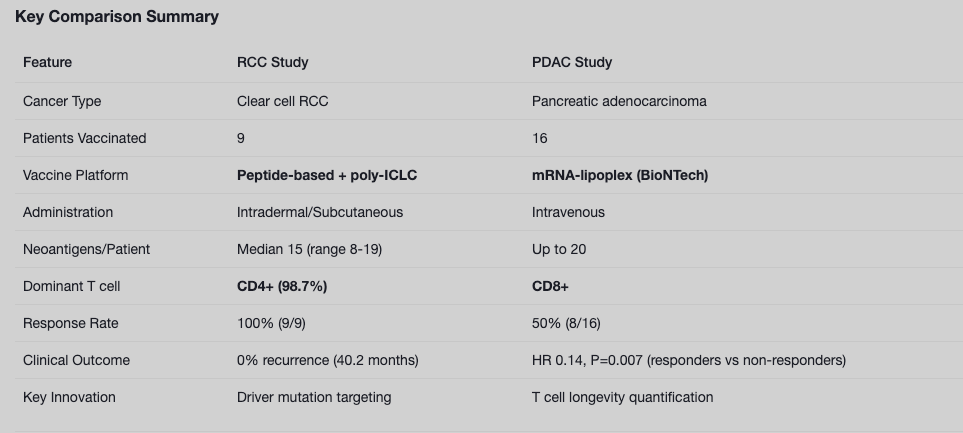
Within minutes, the agent parsed both papers and generated a clear table including all information requested in the prompt. The agent also included other information that was available in both studies that highlights differences in the therapies, such as the administration and dominant responding T-cell population. From this summary, it’s clear that the RCC study used peptide vaccines while the PDAC used mRNA vaccines, but both generated potent antitumor responses and significantly improved clinical outcomes. Notably, both vaccines included several neoantigens per patient, sometimes including up to 20.
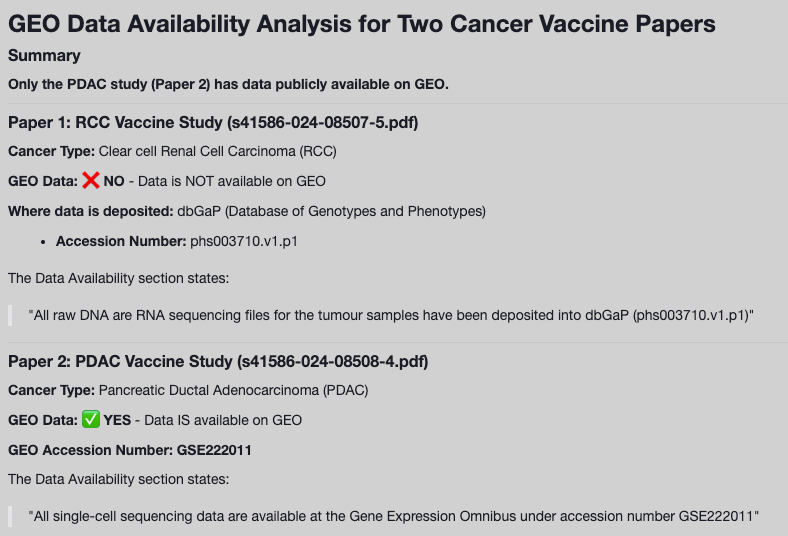
When asked in a follow-up question, the agent was then able to identify if the source data for either paper was available on GEO. The agent found that while the data from Sethna et al. was available on GEO, the data from Braun et al. was available on dbGaP.
We expect the ability to support PDFs will enable the Edison Analysis agent to accelerate a diverse range of workflows across scientific discovery and clinical development tasks.