

Incyte is a global biopharmaceutical company focused on developing therapeutics in oncology, hematology, inflammation, and autoimmunity. Edison Scientific is an AI laboratory focused on bringing superintelligence to medicine. Edison is deploying Kosmos, Edison’s AI Scientist, throughout the pharmaceutical industry to accelerate the discovery and development of life-saving drugs.
Edison Scientific and Incyte are collaborating to develop Kosmos Target Assessment (“Kosmos TA”), a specialized version of Kosmos intended to evaluate drug targets and identify the most promising candidates for development. This partnership combines Incyte’s industry-leading framework for rigorous target evaluation with Edison’s AI capabilities, drawing on Incyte’s historical target decisions and subject-matter expertise, complemented by Edison’s strong scientific AI reasoning.
This work has resulted in broadened assessment coverage, particularly outside the core biological rationale, significant time reduction in target evaluation, and higher confidence in the derisking steps Kosmos TA suggests. These findings highlight an essential role for Kosmos TA in accelerating target assessment through streamlining review preparation and anticipating committee questions.
The challenge
Target selection is one of the earliest and most consequential decisions in drug discovery. Choosing a target means committing to a hypothesis that modulating a particular biological mechanism will deliver therapeutic benefit. Everything downstream, from experimental design to resource allocation, depends on that decision.
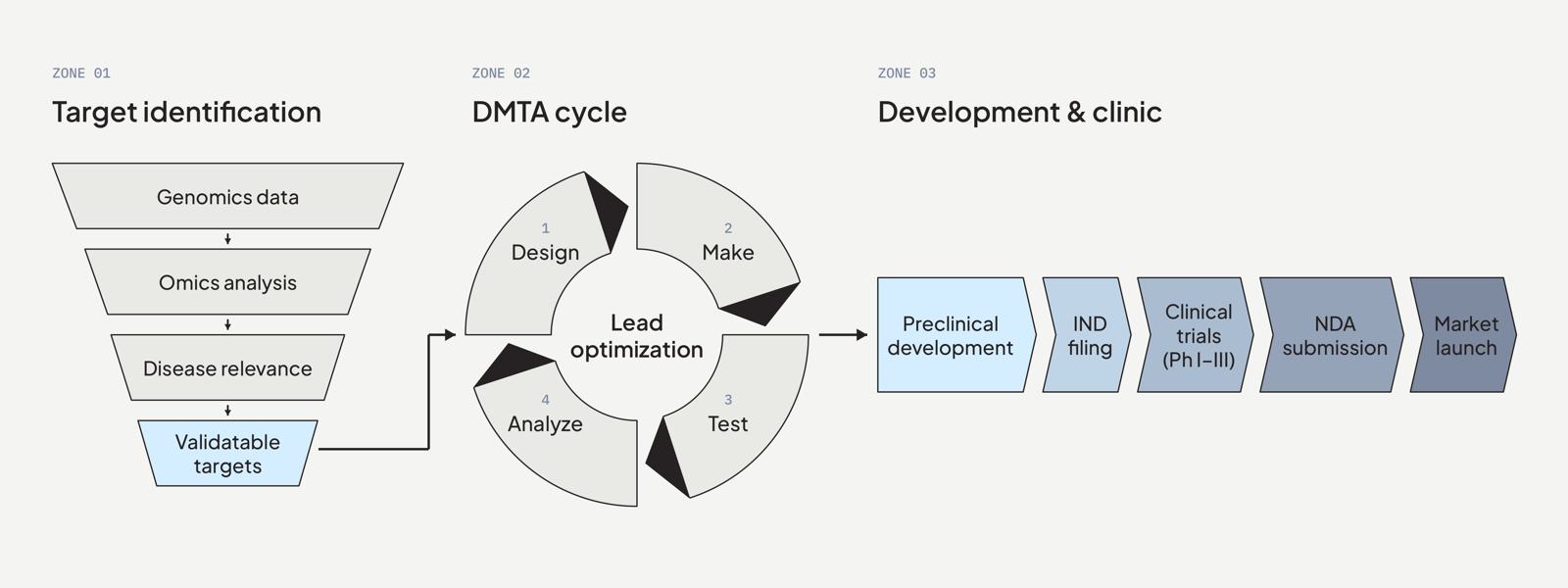
Incomplete evidence can distort target prioritization in two directions. A valuable target may be a false negative and be rejected because the assessment fails to establish a sufficiently compelling opportunity. Surfacing a feasible therapeutic modality or relevant patient population would rescue this false negative. On the other hand, a target may be considered a false positive if it is advanced purely on strong biology without sufficient recognition of liabilities like toxicology concerns or relevant biomarkers. Attrition is inevitable in drug discovery but failures driven by risks already present in the existing evidence are avoidable.
Many of these errors trace back to how target assessments are built. Packages are typically developed by expert scientists with deep knowledge of the relevant biology and they provide a compelling account of disease mechanisms and the rationale for intervention. Yet leadership committees that evaluate targets need broader strategic information in addition to a persuasive biological argument to judge whether a target is worth pursuing. The evidence needed includes safety, tractability, competitive intelligence, portfolio fit, and strategic timing. Often this information is missing from packages, which reduces the quality of decisions and slows down the evaluation process by weeks or months, as scientists must consult additional specialists to assemble further evidence. Conversations with Incyte subject-matter experts also revealed that, because this work relies on specialist availability, the depth of evidence can vary from target to target. This inconsistency is where avoidable attrition often takes root.
Kosmos TA has the opportunity to make target assessments both faster and more comprehensive. By assembling the evidence package before it reaches leadership, Kosmos TA can shorten the path to a decision while giving committees a fuller and more consistent view of every target.
The engagement
Working with Incyte, researchers at Edison built a target assessment agent around the central principle of better evidence coverage while maintaining alignment with human expert judgment. Rather than replacing the scientist’s biological expertise, Kosmos TA is intended to bring deeper and additional perspectives into the assessment earlier. Considerations that might otherwise surface only through senior leadership or cross-functional review can then complement the biology during preparation, instead of arriving as a new set of questions after initial committee review.
This agent workflow treats the assessment as a living evidence package. Updates from literature, patents, and other relevant publications are incorporated as evidence evolves. This eliminates the need for scientists to repeatedly check the same sources manually. The value of this approach includes adding information and also surfacing findings that materially change the assessment.
We evaluated this agent in three ways:
1. Broader coverage of the evidence needed for a decision
To evaluate the quality of evidence provided, we conducted a retrospective comparison of human-prepared and Kosmos TA-generated target assessments, scoring both against a common rubric. We built the rubric directly from transcripts of Incyte target review meetings, capturing the categories and questions that came up most often. We found that Kosmos TA consistently provided significantly higher quality assessments than human-prepared assessments of the same targets.
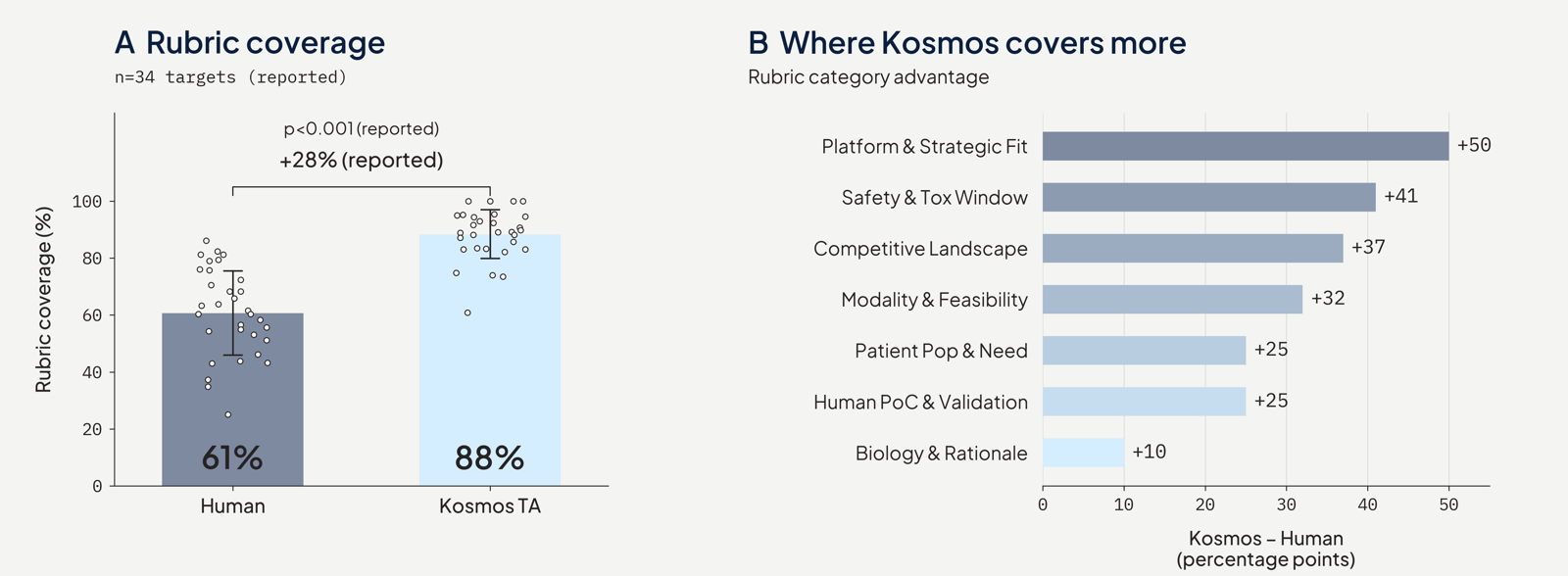
Kosmos TA delivered its biggest gains in the areas outside the core biological rationale, including strategic considerations and portfolio fit. Gains in biological coverage were smaller, which reflects the deep scientific expertise already behind those packages. The result is an assessment that anticipates the committee’s questions before review, letting scientists de-risk targets earlier in the process.
“Kosmos reads through numerous databases, compiling and reconciling the different resources into one cohesive, but comprehensive assessment report.”
Isac Lee, Associate Director, Computational Biology and Data Science, Incyte
2. Assessment across categories in less than one workday
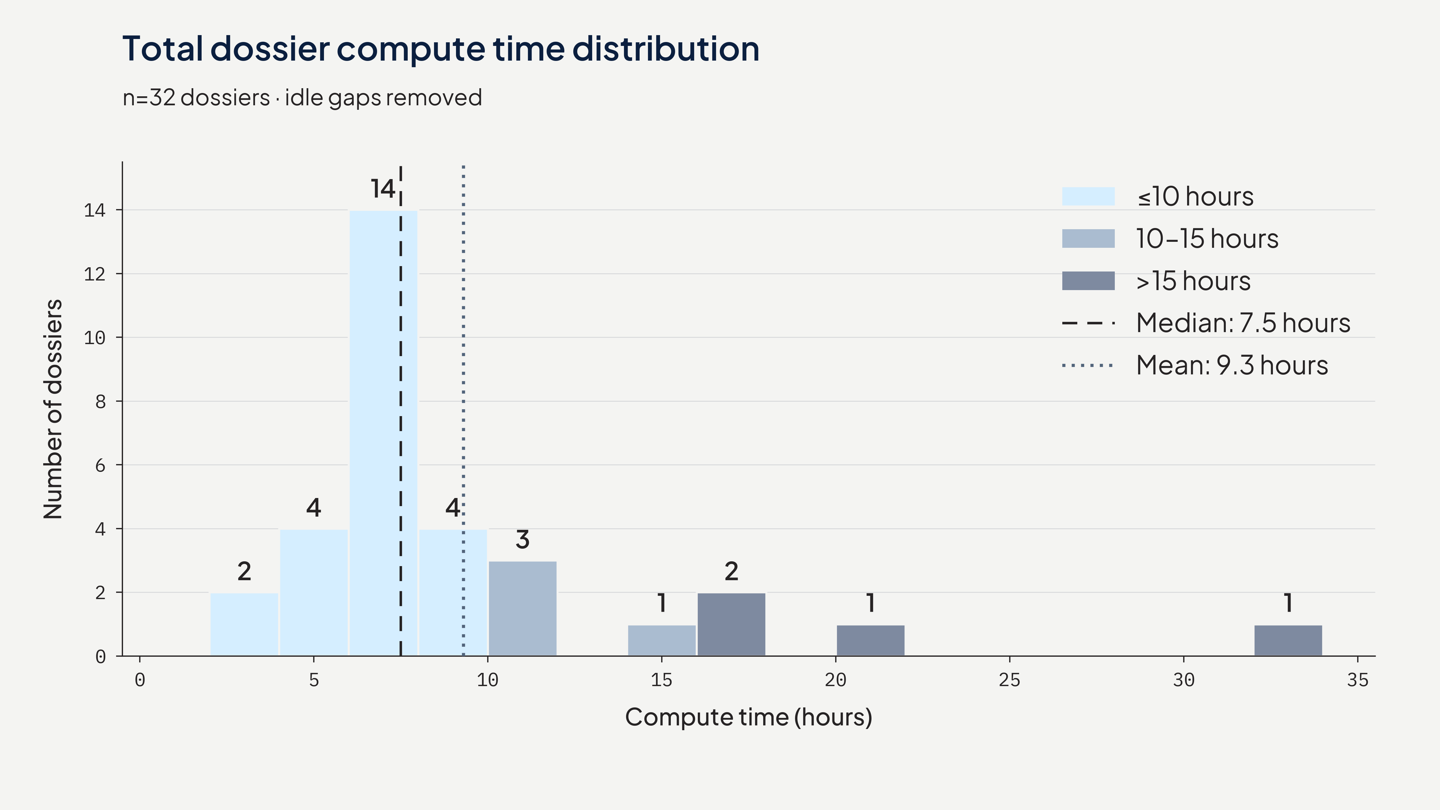
Kosmos TA also dramatically sped up the process of building an evidence package. On average, Kosmos TA assessed a target across all categories in less than one workday. Since a complete package typically draws on multiple specialists, these gains extend well beyond a single scientist, sparing the team the delays of cross-functional handoffs and siloed workstreams. Ultimately, Kosmos TA shifts the way scientists work, giving them more time to interpret data and address unresolved questions.
“Kosmos produced in a morning what would have taken me 3 months of work to complete.”
Pichai Raman, Sr. Director Computational Biology, Incyte
3. Alignment with committee-requested de-risking experiments
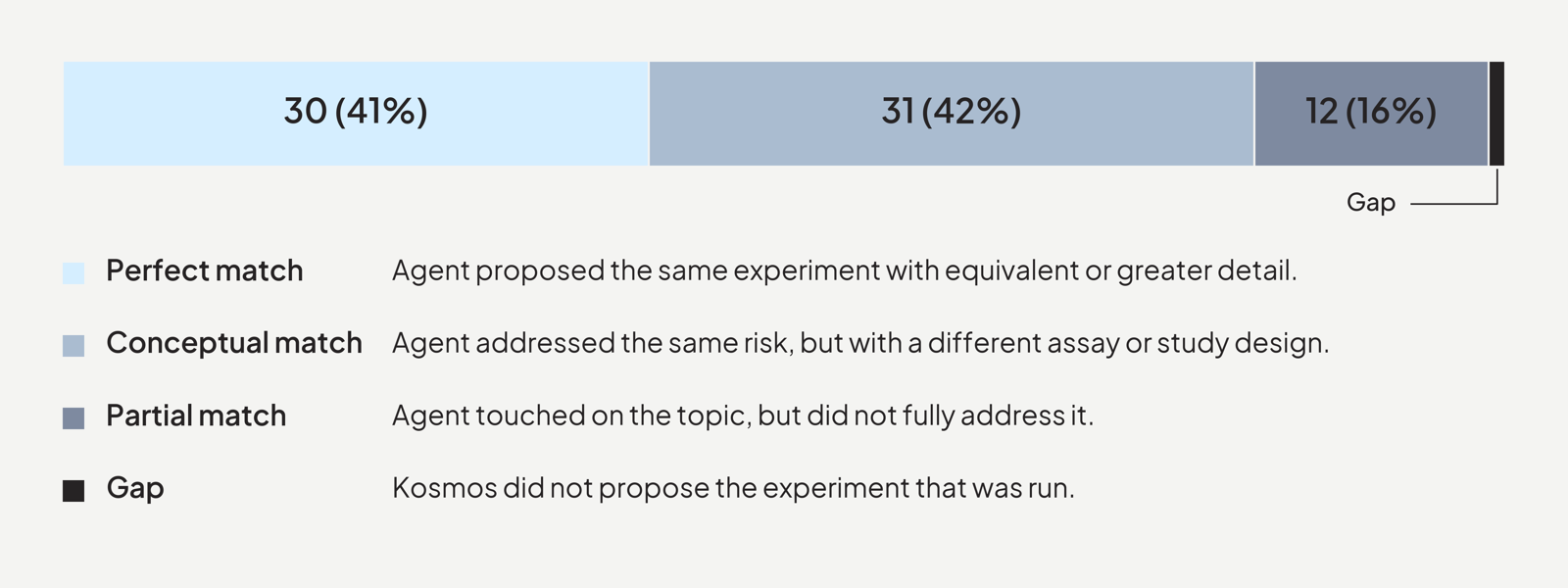
Finally, we evaluated Kosmos TA’s proposals for follow-up experiments on evaluated targets. Determining follow-up experiments for derisking is one of the most important tasks for target assessment committees, so performance on this task is critical for any AI solution. For six targets with known decisions from committee reviews, Kosmos TA was asked to propose the critical experiments needed to de-risk the target. These proposals were compared with the actual experiments requested during the committee review process. We found that Kosmos TA proposed either a perfect match or a conceptual match to the actual experiment in 83% of cases; proposed a partial match in 16% of cases, and only missed a proposed experiment in 1% of cases (corresponding to a single example). Ultimately, Kosmos TA helps scientists surface committee-relevant risks and anticipate follow-up requests which demonstrates strong alignment with expert priorities.
The outcome
Together, these results show that Kosmos TA can meaningfully strengthen expert-led target assessment, producing broader evidence packages with high-quality, actionable experimental follow-ups in less than one workday. Beyond matching historical decisions, Kosmos TA expands what a target assessment can be, surfacing insights that past packages and committee reviews never reached.